.png?width=50&name=download%20(16).png)
Why Free Fish Can’t Buy Real Loyalty Here is a question I ask every executive who hires a coach and...
When the Gas Runs Out: The Nine Behaviors That Define AI-Era Leadership
When the U.S. and Israel struck Iran in late February 2026, every executive watching the news focused on oil. Almost none noticed helium.
That gap — between the signal and the leader who sees it — is the most consequential measurement problem in executive development today.
Qatar supplies approximately one-third of the world's helium (U.S. Geological Survey [USGS], 2025). Its Ras Laffan facility, struck by Iranian drones and forced to declare force majeure, took roughly 30% of global semiconductor-grade helium offline overnight — shifting the market "from oversupplied to undersupplied" (Deutsche Bank, as cited in CNBC, 2026c). South Korea sourced 55% of its helium from Gulf Cooperation Council countries; Taiwan, 69% (CNBC, 2026a). Fitch Ratings placed South Korea's Qatar-specific dependency at 64.7% of total helium imports (Fitch Ratings, 2026). There is no viable substitute in current-generation semiconductor etching processes (Corbett, as cited in Béchard, 2026), and qualifying a new supplier requires months of process requalification — "once a process is established and set up, it's very difficult to change" (Corbett, as cited in Béchard, 2026).
Data centers powering generative AI consume three to five times more electricity than conventional facilities (CNBC, 2026b). Three tech CEOs had independently identified power — not compute — as the binding AI constraint before the war began (MacroMicro, 2025). The conflict compressed a slow-moving structural limit into an acute crisis.
Which leaders will navigate this — and why will some succeed where others, with identical resources and strategies, will fail?
You Already Know the Answer
Before reading further, notice what you already believe: that leadership behaviors predict outcomes better than leadership traits. That development without objective measurement is guesswork. That the AI era demands capabilities existing assessments were not built to measure (Cialdini, 2016).
What the Crisis Reveals
Environmental Scanning. The leaders who saw this coming were sensing weak signals before they materialized as crises. The Semiconductor Industry Association warned in 2023 that helium supply disruption would likely produce "shocks to the global semiconductor manufacturing industry" (Semiconductor Industry Association [SIA], 2023). The KPMG Global Semiconductor Outlook flagged energy security and supply chain fragility in December 2025, with executives warning they might not be able to procure sufficient energy for advanced fabrication (KPMG & Global Semiconductor Alliance, 2025). The signals were present. They required a leader behaviorally wired to find them. When AMD CEO Lisa Su announced the Helios rack-scale platform at CES 2026, she was enacting years of upstream scanning that had identified memory bandwidth — not raw compute — as the binding constraint in AI inference workloads (Burke, 2026).
Boundary-Bridging and Digital Orchestration. Managing the crisis demands translation across procurement, geopolitics, materials science, energy policy, capital allocation, and competitive strategy simultaneously. Closed-loop recycling exists in some sectors but has not been broadly deployed in chipmaking (Corbett, as cited in Béchard, 2026). Capital project timelines must align with realistic supply conditions, not merely approval decisions (Deloitte, 2025). Without a leader who can move fluidly across all of these boundaries, organizations remain paralyzed. Paired with Boundary-Bridging is Digital Orchestration: governing emergency procurement, sustaining engineer trust, and redesigning capital allocation frameworks under genuine uncertainty — simultaneously.
Strategy. Organizations that invested before the crisis in helium recycling infrastructure, diversified supply agreements, or reduced helium intensity through architectural innovation now hold structural advantages no late-mover can replicate quickly. Supply chain resilience consistently lags demand growth in ways that make early strategic optionality irreversible in its advantage (Deloitte, 2025).
Adaptability, Resilience, and Coachability. Jensen Huang's framing of physical constraints as "collective design problems" — not threats — at CES 2026, where he unveiled the Vera Rubin AI platform and called for the ecosystem to "come together," is the behavioral signature of Adaptability (Burke, 2026). Resilience holds strategic foresight under pressure while the ground shifts. Coachability allows a leader to rebuild the strategy the crisis has invalidated. A leader whose AI strategy assumed abundant cheap compute now needs the intellectual humility to start over.
Charisma and Persuasion. The solutions require coalitions no single organization can build alone. When Su brought HP CEO Enrique Lores, Lenovo's Luca Rossi, and other senior partners to the CES 2026 stage rather than headlining alone, she demonstrated Charisma in its most sophisticated form: the use of Collective Sentiments and social proof to inspire commitment across a heterogeneous ecosystem (Burke, 2026). The team-level mechanism is Persuasion — applying Cialdini's Core Motives sequence: cultivate relationships first, then reduce uncertainty through authority and peer consensus, then motivate action through scarcity and consistency framing of the first-mover window. Leaders who pre-suade before they persuade will build the required coalition. Those who lead with directives will compound the constraint.
The Precision Gap
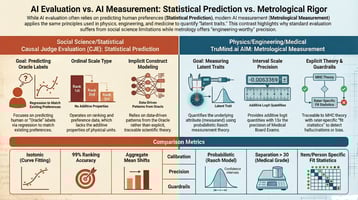
What executive coaches have not had is before-and-after evidence that a sponsor finds credible. What they have not had is a system precise enough to demonstrate that the Boundary-Bridging behaviors cultivated in Session Four were still operational twelve weeks later in a cross-functional meeting the coach was not in the room for. What they have not had is measurement derived not from what leaders say they would do on a survey, but from what they actually do in the unguarded texture of real conversation (TruMind.ai, 2026).
TruMind.ai's AI Precision Measurement (AIM) engine closes that gap. The scribe joins existing coaching sessions — Zoom, Teams, Google Meet, any platform — and delivers two reports at session close: full scoring of all nine leadership dimensions and all eight ICF coaching competencies from the transcript, plus the next optimal powerful questions calibrated to the client's specific developmental zone. Fifteen times the precision of traditional high-stakes assessments (TruMind.ai, 2026).
The Question Consistency Is Asking You
A shortage of watts is becoming a shortage of wafers. A shortage of wafers is becoming a shortage of leaders who saw it coming.
The leaders who will define 2030 are in someone's coaching pipeline right now. The question your professional identity is now asking — in the language of Cialdini's (2016) deepest consistency principle — is this: are the measurements you use as precise as the claim you make when you say the development is working?
When you finish reading this, try one free session with our AIM scribe active. This can be for a discovery or chemistry call, or an actual live coaching client. Simply add notes@trumind.ai as a participant and see what you’ve been missing.
References
Béchard, D. E. (2026, March 18). The AI boom is dangerously dependent on helium. Scientific American. https://www.scientificamerican.com/article/the-iran-war-disrupts-global-helium-supply-and-artificial-intelligence-chip/
Burke, B. (2026, January 12). At CES, NVIDIA Rubin and AMD "Helios" made memory the future of AI. Futurum Research. https://futurumgroup.com/insights/at-ces-nvidia-rubin-and-amd-helios-made-memory-the-future-of-ai/
Cialdini, R. B. (2016). Pre-suasion: A revolutionary way to influence and persuade. Simon & Schuster.
CNBC. (2026, March 19). The Iran war is threatening supply of a little-thought-of resource — helium. What it means for the markets. https://www.cnbc.com/2026/03/19/the-iran-war-is-threatening-supply-helium-what-it-means-for-markets.html
CNBC. (2026, March 10). How the Iran war and rising energy prices are threatening semiconductor demand. https://www.cnbc.com/2026/03/10/iran-war-semiconductor-memory-chip-impact.html
CNBC. (2026, March 27). The tech download: How Russia could profit from Iran war helium supply chain disruption in the chip sector. https://www.cnbc.com/2026/03/27/russia-helium-supply-crunch-iran-war.html
Deloitte. (2025, December 24). New technologies and familiar challenges could make semiconductor supply chains more fragile. Deloitte Insights. https://www.deloitte.com/us/en/insights/industry/technology/technology-media-and-telecom-predictions/2026/new-supply-chain-tech.html
Deutsche Bank analysts. (2026, March 12). [Note on Qatar helium production shutdown shifting the market from oversupply to undersupply]. Cited in CNBC. (2026, March 27). How Russia could profit from Iran war helium supply chain disruption in the chip sector. https://www.cnbc.com/2026/03/27/russia-helium-supply-crunch-iran-war.html
Fitch Ratings. (2026, March 17). Prolonged Iran conflict raises helium tail risk for semiconductors [Fitch Wire]. Cited in TASS. (2026, March 17). Prolonged Middle East conflict could hit semiconductor market — Fitch. https://tass.com/economy/2102831
KPMG & Global Semiconductor Alliance. (2025, December 16). AI-boom drives semiconductor industry confidence to near-record high, but supply chain and infrastructure concerns intensify [Press release]. KPMG LLP. https://kpmg.com/us/en/media/news/ai-boom-drives-semiconductor-industry-confidence.html
MacroMicro. (2025). Outlook 2026 series IV: The AI power endgame — the infrastructure race from chips to the grid. https://en.macromicro.me/blog/outlook-2026-series-iv-the-ai-power-endgame-the-infrastructure-race-from-chips-to-the-grid
Rand Technology. (2025, November 6). AI arms race: Electronics supply chain 2025. https://randtech.com/ai-arms-race-electronics-supply-chain-2025/
Semiconductor Industry Association. (2023, March 16). Helium supply risk: Comments in response to U.S. Geological Survey request for information. https://www.semiconductors.org/wp-content/uploads/2023/03/SIA-Comments-to-USGS-Request-for-Comment-on-Helium-Supply-Risks-3_16_23.pdf
TASS. (2026, March 17). Prolonged Middle East conflict could hit semiconductor market — Fitch. https://tass.com/economy/2102831
U.S. Geological Survey. (2025). Mineral commodity summaries 2025: Helium. U.S. Department of the Interior. https://pubs.usgs.gov/periodicals/mcs2025/mcs2025-helium.pdf