In 2019, WeWork's Adam Neumann sat across from his executive coach in what would be one of their...
The Question That Fits: Why Asking the Right Thing (at the Right Level) Changes Everything
You've had this moment.
You ask a question you've used a hundred times. It worked last session. It worked the session before that. This time it lands flat. The client gives you a one-word answer. They look confused. Defensive. Or they just shrug.
You wonder if you lost your touch.
You didn't. The question wasn't wrong. The level was.
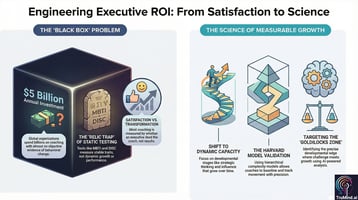
Lev Vygotsky figured this out over 90 years ago. He called it the Zone of Proximal Development. The space between what someone can do alone and what they can do with guidance. Too easy and the mind coasts. Too hard and it shuts down. Growth happens right in the middle.
Every experienced coach knows this intuitively. You calibrate by feel. You watch body language. You listen for the flicker of confusion or the spark of recognition. And when you're good, it works.
But here's what nobody tells you. You're still guessing. Educated guessing, sure. But guessing.
### Three Versions of One Question
Take a domain most coaches work with: influence and persuasion. A client wants to be more persuasive with the people around them. Here's the generic version.
*What influence strategies are you using with your stakeholders?*
That's a good question. Open-ended. Relevant. The kind you learn in coaching programs. And it fits about as well as a suit off the rack. It fits nobody in particular.
Now watch what happens when you calibrate.
**For a Stage 7 client (concrete, rules-based, single-perspective):**
"You mentioned you want more influence with your boss. What specific rule or process have you tried following to get what you need from them, and how did it work?"
Look at what changed. Stage 7 thinking is concrete cause and effect. One relationship at a time. This question meets the client where they actually are. It asks about one person, not a network. It asks what rule they followed, not what patterns they see. It asks for behavioral recall -- "how did it work" -- not abstract analysis.
The client can answer this. It's in their zone.
**For a Stage 12 client (systematic, comparative, multi-context):**
"As you look across the different stakeholders you need to influence -- your board, your direct reports, your cross-functional peers -- which influence principles are you finding most effective with each group, and how are you sequencing them across the relationship lifecycle to set conditions before each key ask?"
This question requires systematic thinking. It asks the client to hold multiple stakeholder systems in mind at once. Compare and contrast across contexts. Think about sequencing and timing. It activates what the Sleuth Protocol calls the detective mindset -- the client becomes an investigator of their own influence terrain, mapping which principles work where and why.
A Stage 7 client drowns in this question. A Stage 12 client finds it energizing. They have the cognitive architecture to handle it.
Same topic. Same goal. Radically different questions.
### The Invisible Variable
The content is the same in all three -- influence. The difference is the cognitive demand. The first asks for concrete behavior. The second asks for systematic integration. A powerful question at the wrong level is just noise.
This is what Vygotsky understood. The zone is specific. It depends on where the person actually is, not where you assume they are.
Most coaches can ask the generic version. Some calibrate intuitively part of the time. But without seeing the client's actual developmental level, you're working blind. You make good guesses. You'll be right a lot. But you'll also miss. And when you miss, the session stalls.
TruMind measures MHC level from a single coaching transcript. One conversation. It identifies exactly where each client sits across 9 leadership dimensions and 8 ICF competencies. The coach report shows you which stage they're operating from. And it surfaces the next Powerful Question calibrated to their Goldilocks Zone.
Not a question you hope fits. The question that actually does.
Try TruMind for free with your next chemistry session. One conversation is enough. See your client's MHC level. Get your calibrated questions. Find out what happens when you stop guessing. Just add our scribe, (notes@trumind.ai) and in a day we'll send you two reports that focus your coaching with suggested optimal powerful questions