

What's the one leadership skill no assessment can measure? Answer: What actually happens when...
The Psychometric Revolution: Why the Future of Leadership Assessment Is Invisible
Our founder has been pioneering AI in Organizational Psychology since the 1990s, and in 2018 won the Society for Industrial-Organizational Psychology's Bray-Howard Award for a novel Natural Language approach to AI psychometrics (Barney & Riley, 2018). Then, with the advent of LLMs, he was asked to write about Trumind.ai's method in a metrology journal (Barney & Barney, 2024). The rest of the industry is playing catch up. For example, Frontiers in Organizational Psychology recently published a review examining AI's impacts on the development and validation of psychological measurement scales (Stanton et al., 2026).
The science has evolved. The market has moved. What remains is what you do with this information.
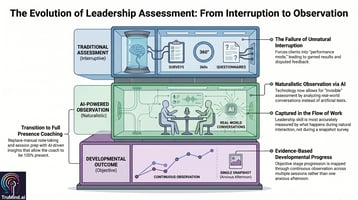
You already know the uncomfortable truth that nobody in the industry says aloud: the way we assess leadership is broken. A single survey, administered once a year, in an artificial context, with a two-week turnaround, producing a static report that sits in a drawer. This is not assessment. This is photographing a river and calling it the river.
Coaches, mentor coaches, coach trainers, and assessment distributors—you have built your expertise on validated instruments and personality frameworks (Hogan & Hogan, 2007; McCrae & Costa, 2008). You believe in measurement. You believe in evidence. And you know that current delivery mechanisms betray that belief.
Your clients deserve better. Your practice deserves better. The science has finally caught up to what you suspected all along.
The Problem
Traditional leadership assessment suffers from three fatal flaws.
It is episodic. You capture a person at one moment and extrapolate their leadership capacity. But leadership is not a trait you possess; it is a behavior you enact—and it shifts with context, stress, and organizational pressure (Mischel, 2004). A point-in-time instrument cannot capture what a continuous signal can.
It is intrusive. The very act of administering an assessment changes the behavior it measures. Leaders know they are being evaluated. They perform. They game. They give the answer they think the organization wants (Ziegert et al., 2011). Assessment becomes theater, not diagnosis.
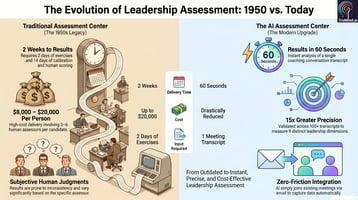
It has low utility. By the time the report arrives, the moment has passed. The leader has moved on. The challenge has evolved. Assessment should inform development in real time, not retrospectively explain what already happened (London & Smither, 1995).
Picture checking your glucose once yearly versus a monitor beeping warnings mid-meal. The yearly check explains; the monitor prevents.
This is not a critique of the instruments. Hogan, the Big Five, the competency models you work with daily—these are scientifically robust (Goldberg, 1993; Hogan & Hogan, 2007). The problem is the delivery mechanism. Like monitoring a patient's heart with a single EKG per year and calling it healthcare.
The Research Foundation
The scientific community has been building toward something fundamentally different.
Forbes (Eliot, 2025) demonstrated empirically that LLMs function as psychometric instruments—not replacing validated tools, but extending their reach into natural language and behavioral signals leaders produce daily.
Nature Machine Intelligence (Serapio-García et al., 2025) established a psychometric framework for evaluating and shaping personality traits in LLMs, showing that properly structured language-based signals produce profiles with construct validity—while capturing data those instruments simply cannot access.
Frontiers (Stanton et al., 2026) examined AI's impacts on measurement scale development, noting both the promise of AI-generated items and the risks of semantic drift where items exhibit face validity without meeting statistical quality criteria. The conclusion: AI does not replace psychometrics. It transforms the data collection layer—but requires rigorous validation to ensure constructs are precisely delineated through iterative theory-building and empirical testing.
The Solution
TruMind.ai has built a platform that operationalizes this research into a practical, defensible assessment system resting on three principles.
|
Aspect |
Traditional |
TruMind.ai |
|---|---|---|
|
Frequency |
Annual snapshot |
Daily continuous |
|
Bias |
High (gaming/performance) |
Low (natural behavior) |
|
Utility |
Retrospective PDF |
Trend dashboard |
|
Data Source |
Self-report survey |
Workflow signals |
Invisible assessment. Instead of pulling leaders out of their workflow, TruMind analyzes behavioral signals they already produce—communication patterns, decision documentation, meeting dynamics, feedback exchanges. The leader does not know they are being assessed because they are simply leading. Performance bias collapses (Ziegert et al., 2011).
Continuous measurement. Instead of a single annual snapshot, TruMind produces a continuous stream. You see how competencies shift under stress, how team dynamics evolve, how decision-making changes with complexity. Not a report. A dashboard.
Actionable intelligence. Instead of a 40-page PDF explaining what happened six months ago, TruMind delivers real-time insights that inform coaching conversations, development plans, and organizational decisions when they matter (London & Smither, 1995). The gap between assessment and intervention collapses to zero.
The platform maps to three leadership domains and nine precise dimensions:
- Leading Self: Adaptability, Coachability, and Resilience—measured continuously through behavioral signals, not self-report
- Leading Team: Boundary-Bridging, Charisma, and Persuasion—observed in actual interactions, not hypothetical scenarios
- Leading Organization: Environmental Scanning, Strategy, and Digital Orchestration—tracked through real decisions and outcomes
This is not a replacement for instruments you trust. It is a complement operating at different resolution, on a different timescale. Instruments measure potential. TruMind reveals the performance gap—where leaders think they are versus where data shows they are. Rasch-scaled traditional scores (0–100; Bond & Fox, 2015) versus TruMind's dynamic trajectory (e.g., Self-awareness: 72 → 85 under stress). See the growth curve live.
For coaches pursuing ICF PCC credentialing: this transforms intuitive breakthroughs into objective evidence (International Coaching Federation, 2024). For mentor coaches: this provides defensible verification of client development. For assessment distributors: this converts episodic sales into continuous client relationships.
The Hard Questions
Privacy. TruMind does not collect raw communications. It extracts behavioral signals—patterns, frequencies, structural features—and maps them to validated frameworks. Data is aggregated, anonymized where appropriate, and governed by explicit consent (European Parliament, 2016). The leader owns their data. The organization owns aggregate insights. This is measurement with consent, not surveillance.
Validity. The Nature Machine Intelligence and Frontiers research demonstrates AI-based assessment can achieve construct validity when properly structured (Serapio-García et al., 2025; Stanton et al., 2026). When continuous and point-in-time signals converge, confidence increases. When they diverge, that divergence is itself diagnostic—revealing the gap between self-perception and behavior.
Bias. AI inherits training data biases (O'Neil, 2016) and may generate items with face validity that lack statistical quality (Stanton et al., 2026). TruMind addresses this through transparent methodology (see exactly what signals are measured and how), continuous calibration (regular validation against established instruments to detect drift), and human-in-the-loop oversight (assessment professionals review insights before they inform decisions). Bias is not eliminated. It is managed, monitored, and made visible.
The Choice
The leaders and organizations you serve are already being assessed by AI systems. They just do not know it. Performance management platforms, communication analytics, engagement surveys—all collect behavioral data and draw conclusions about leadership capacity. Unvalidated tools assess your clients invisibly, without your expertise, without psychometric rigor, without theoretical grounding.
You have a choice. Let unvalidated AI tools capture your clients' leadership data and produce conclusions you cannot stand behind. Or lead the integration of scientifically grounded, continuously operating assessment into your practice.
Imagine a coaching practice where you see real-time patterns—the communication habits undermining trust, the decision tendencies creating bottlenecks, the stress responses derailing teams. Where interventions are informed by actual behavior, not self-report. Where impact is measurable by observable change in leadership capacity, not satisfaction surveys.
Imagine an assessment distribution business where instruments are continuous relationships, not episodic events. Where your value is interpreting a living signal, not administering a test. Where clients experience assessment as development that helps them lead better, starting today.
This is not a future state. The science exists. The technology exists. The market is already moving.
The psychometric revolution is not coming. It is here. The question is whether you will lead it or be led by it.
TruMind.ai is the infrastructure for leadership professionals who choose to lead. [Request your demo today.]
References
Barney, M.F. & Riley, B. (2018, April). Demonstrating a novel Natural Language Assessment of Persuasion. Douglas W. Bray & Ann Howard Research Grant Awarded. Society for Industrial and Organizational Psychology Awards Committee. Bowling Green, OH.
Barney, M. & Barney, F. (August 26, 2024). Transdisciplinary Measurement through AI: Hybrid metrology and psychometrics powered by large language models. In W.P. Fisher Jr., & L. Pendrill (Eds.). Models, Measurement, and Metrology extending the Systeme International d'Unités. De Gruyter. https://www.degruyterbrill.com/document/doi/10.1515/9783111036496-003/html
Barney, M., Wind, S., & Krishna, V. (January 2, 2026). Using large language models to evaluate ethical persuasion text: A measurement modeling approach. International Journal of Assessment Tools in Education, 13(1), 224–247. https://doi.org/10.21449/ijate.1788563
Barney, M.F. (2026, January 28). Diversity Reboot: Kaleidoscope Liberty and Cross-Cultural AI for People and Profit. XLNC Scientific Publishing. ISBN: 979-8-218-92933-6 https://trumind.ai/diversity
Bond, T. G., & Fox, C. M. (2015). Applying the Rasch model: Fundamental measurement in the human sciences (3rd ed.). Routledge.
Eliot, L. B. (2025, November 24). Generative AI and LLMs are valuable psychometric instruments for gauging human mental health at scale. Forbes. https://www.forbes.com/sites/lanceeliot/2025/11/24/generative-ai-and-llms-are-valuable-psychometric-instruments-for-gauging-human-mental-health-at-scale/
European Parliament. (2016). Regulation (EU) 2016/679 of the European Parliament and of the Council (General Data Protection Regulation). Official Journal of the European Union, L119, 1–88.
Goldberg, L. R. (1993). The structure of phenotypic personality traits. American Psychologist, 48(1), 26–34. https://doi.org/10.1037/0003-066X.48.1.26
Hogan, R., & Hogan, J. (2007). Hogan Personality Inventory manual (3rd ed.). Hogan Assessment Systems.
International Coaching Federation. (2024). ICF core competencies and credentialing standards. https://coachingfederation.org/credentials-and-standards
London, M., & Smither, J. W. (1995). Can multi-source feedback change perceptions of goal accomplishment, self-evaluations, and performance-related outcomes? Theory-based applications and directions for research. Personnel Psychology, 48(4), 803–835. https://doi.org/10.1111/j.1744-6570.1995.tb01784.x
McCrae, R. R., & Costa, P. T., Jr. (2008). The five-factor theory of personality. In O. P. John, R. W. Robins, & L. A. Pervin (Eds.), Handbook of personality: Theory and research (3rd ed., pp. 159–181). Guilford Press.
Mischel, W. (2004). Toward an integrative science of the person. Annual Review of Psychology, 55, 1–22. https://doi.org/10.1146/annurev.psych.55.042902.130709
O'Neil, C. (2016). Weapons of math destruction: How big data increases inequality and threatens democracy. Crown.
Serapio-García, G., Safdari, R., Creber, A., Dill, K., Cui, Y., Kajiwara, T., & Fitzpatrick, M. (2025). A psychometric framework for evaluating and shaping personality traits in large language models. Nature Machine Intelligence, 7, 1–12. https://doi.org/10.1038/s42256-025-01115-6
Stanton, J. M. (2026). Mini Review: considering impacts of artificial intelligence on the development of measurement scales. Frontiers in Organizational Psychology, 4, 1787155. https://doi.org/10.3389/forgp.2026.1787155
Ziegert, J. C., Hanges, P. J., & Dickson, M. W. (2011). More than a metaphor: The impact of faking on assessment center construct validity. Journal of Applied Psychology, 96(5), 940–953. https://doi.org/10.1037/a0023542
Last month, a senior VP looked at her Hogan debrief and asked the question that changes everything:
"So what do I actually do with this?"
If you've been in assessment distribution for more than a year, you've heard it. That pause after the debrief. The nod that says "interesting" but means "I'm not sure this changes anything." The report that gets filed, not lived.
You chose Hogan because you chose science over shortcuts. Over 560 peer-reviewed publications. A PhD-led team that has spent decades mapping the architecture of personality—the bright side (HPI), the dark side (HDS), the inside (MVPI). You built your practice on instruments that tell the truth about people when mirrors won't.
That choice was right. It remains right.
But the ground is shifting beneath it.
The Gap You Can Feel
Here's what's happening in 2026: Your clients are encountering AI everywhere else in their lives. Their fitness app adapts to their patterns. Their investment platform simulates their retirement. Their navigation reroutes in real-time.
Then they come to their coaching session and receive a static report about their personality.
The science is impeccable. The experience is... 2019.
This is the AI Gap, and it's widening. Not because Hogan's science is wrong—it isn't—but because the delivery of that science hasn't kept pace with what clients now expect from intelligent systems.
Three recent developments make this concrete:
Procedural Coaching Architectures (arXiv: 2604.17624, April 2026): AI can now follow multi-step coaching protocols that adapt in real-time to cognitive load and emotional state. Not chatbots. Coaching procedures that unfold based on who the client is becoming in this moment.
AI-Driven Well-being via GROW (arXiv: 2604.04548): Generative models fine-tuned on the GROW framework can now deliver nuance previously reserved for human executive coaches—specifically targeting psychological well-being, not just performance.
Personality-Informed Negotiation Simulation (arXiv: 2604.00464): AI can model personality traits to predict and simulate complex negotiation outcomes. A "flight simulator" for the interpersonal dynamics that derail leaders most.
Each of these advances requires validated personality data to function. Without it, they're high-speed guesswork. With it, they become precision instruments.
The Synthesis That Changes the Math
Here's what most distributors miss: Hogan and AI aren't competitors. They're complements—when you architect the integration correctly.
Hogan shows who the client is. The empirical boundaries. The client's reputation that will carry through the entire coaching engagement.
AI provides a delivery accelerator. The behaviors that are actionable in the moment rather than interesting in the report.
Together, they produce something neither can alone:
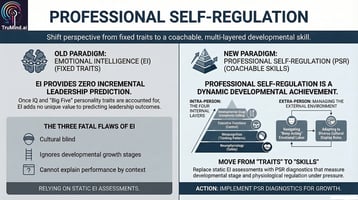
What Clients Get Now
What They Could Get
"Your HDS suggests you may become volatile under pressure"
"Based on your HDS pattern, here's how volatility limits your Resiliency and could manifest in Thursday's board meeting—and here's the specific cognitive reappraisal to deploy when you feel it rising"
A 40-page report that gets filed
A continuous coaching companion that adapts as they develop
Annual reassessment to track change
Real-time developmental tracking from actual conversations
"Work on your interpersonal sensitivity"
"Your Goldilocks Zone for persuasion is here—this is your optimal next step, calibrated to your current developmental level"
The difference isn't incremental. It's the difference between a map and a navigation system. Both are accurate. One gets you there.
The Distributor's 2026 Position
You have a choice that will define the next decade of your practice:
Option A: Continue offering impeccable science in a format that increasingly feels static to clients who are being trained by every other system in their lives to expect intelligence, adaptation, and real-time guidance.
Option B: Compliment Hogan's validated substrate with AI's procedural capabilities, offering clients more science they trust delivered in the experience they now expect.
Option A is safe—until it isn't. The distributors who will lead in 2027 are the ones who recognize that the question isn't "Should AI enter my practice?" but "Will I be the one who integrates it with the science my clients trust, or will someone else do it without that foundation?"
Your Next Step
This isn't about replacing anything. It's about adding a layer that makes your existing Hogan investment more valuable—because it becomes actionable rather than just informative.
Step 1: See it. Add notes@trumind.ai to your next chemistry session. The scribe joins, records, transcribes. Zero behavior change. You'll receive two reports: client leadership dimensions plus ICF competencies with 15× the precision of subjective assessment.
Step 2: Experience the gap. Compare what you sense about your client's development with what the transcript analysis shows. That gap is where your competitive advantage lives.
Step 3: Decide. Whether to offer your clients static reports in an adaptive world, or validated science delivered through intelligent coaching that meets them where they are—and shows them where they're going.
The science you chose was right. The question is whether the delivery will keep pace with what your clients now expect from intelligence.
TruMind.ai bridges Hogan's validated personality science with procedural AI coaching. Zero friction. 15× precision. Goldilocks Zone personalization. Connect for a demonstration